Right about the colony, right about the sugar, and a century early on how food shapes a bee. Here's the full scorecard.
TL;DR
In late 1923 Rudolf Steiner gave a run of talks on bees to the workmen at the Goetheanum in Switzerland, mostly answering questions from a beekeeper named Müller.
His best-known warning: buying artificially bred queens would pay off at first, but “this joy will not last a hundred years.”
Not every detail has held up, but three ideas have aged especially well: the hive is one being, bees should eat what flowers give them, and squeezing a colony for short-term yield sends a bill later.
He barely mentioned pollen. A century of research says that's where much of the story is. Stored pollen, called bee bread, helps decide which larvae become workers, feeds the nurse bees that make royal jelly, and carries plant compounds that switch on bees' detox and immune genes.
A Room Full of Carpenters, 1923
On a hill above the Swiss village of Dornach, the first Goetheanum had burned to the ground on New Year's Eve 1922. It was the great carved-wood headquarters of anthroposophy, the spiritual movement founded by Rudolf Steiner. The carpenters and craftsmen who built it were still on site.
Steiner is better known today for what grew out of his ideas: Waldorf schools and biodynamic farming. But since the year before, he had also been giving the building crew regular talks, and the workers chose the subjects. One of them kept bees. The transcripts call him only Herr Müller. In November 1923 Müller gave a talk on bees himself. After that, the questions kept coming back to the hive, and Steiner answered them over eight lectures between late November and the week before Christmas.
On December 5, Müller pushed back on one of Steiner's warnings. He couldn't see why colonies should fail within a century. Steiner didn't argue the point. He parked it:
“Let us speak again in a century, Herr Müller, and see what view you hold then. That is something that cannot be decided today.”
That century came due in December 2023. Müller isn't here to give his answer, so we went back to the German transcripts and checked what Steiner actually said against a hundred years of bee science.
Before we start: how to read these talks
Steiner was a philosopher and spiritual researcher, not a laboratory biologist. These talks were improvised answers to workmen's questions, taken down by a stenographer and never revised, and the editors of the German edition note where his accounts differ from one talk to the next.
So we read them the way you'd read any hundred-year-old field notes. Some details have been overtaken by later measurement. Others were decades ahead of the science. What stands out is how many of his instincts about bees have since been borne out.
The Warning: “This Joy Will Not Last a Hundred Years”
By 1923, queens had become a product. Left alone, a colony raises its own queen from one of its own larvae. But in 1889 the American beekeeper G. M. Doolittle had published a method for moving young larvae into artificial cups and raising queens in bulk, and by the 1910s firms were shipping queens and packaged bees in volume. Müller told Steiner that raising queens this way had caught on only in the previous twelve to fifteen years.
Steiner didn't deny it worked. On November 10 he granted that artificial breeding could “enormously increase honey production, the whole work, even the working capacity of the worker bees.” Then came the warning:
“In a hundred years all beekeeping would cease if one used only artificially bred bees… Beekeepers may be extremely pleased at the boom beekeeping has recently taken; but this joy will not last a hundred years.”
His reason, two weeks later, was the relationship inside the colony. A queen the colony raises itself grows up in “intimate kinship” with its workers, he said, and a bought queen can't have that. The loss wouldn't show at first. Over decades, “the strong cohesion of a bee family” would wear away.
Two things usually get lost when this passage is quoted online:
- He never said “80 to 100 years.” In the transcript, that figure appears only in the stenographer's summary of Müller's objection, and it spread through later retellings. Steiner's own words were “a hundred years,” and at other times “fifty or eighty” or “fifty, sixty.”
- He refused to turn it into a crusade. He said he didn't want a “fanatical movement” against artificial breeding, and that for the time being one could have nothing against it.
So how did the century go?
In the winter of 2006–07, American beekeepers began reporting losses of 30 to 90 percent of their hives, with the adult workers simply gone. The syndrome got a name, Colony Collapse Disorder, and Steiner's warning found a new audience. The 2010 documentary Queen of the Sun opened its story with it.
Twenty years on, losses are still severe. In the year to April 2025, US beekeepers lost 55.6 percent of their colonies, the worst figure since the national survey began in 2010. The following year's preliminary figure was 39.9 percent, close to the 15-year average of 42. In the United States, losing four colonies in ten every year is now normal.
Here's the honest part. The causes researchers point to are the Varroa mite and the viruses it spreads, pesticides, and poor nutrition as wild forage disappears, with management stress on top. Queen breeding isn't on that list, and Steiner never foresaw Varroa. Anyone who says he “predicted colony collapse” is reading more into the transcript than is there.
But look at where some of the best research of the last twenty years has landed:
- Diversity pays off. On her mating flights a queen normally mates with many drones. Biologists Heather Mattila and Thomas Seeley found that colonies whose queen had mated with many drones got new nests going faster, stored more food and survived the winter better than colonies whose queen had mated with just one.
- Colonies that swarm carry fewer mites. Seeley's group housed some colonies in small hives and let them swarm, and kept others in large hives with swarming prevented. Over two years, the colonies that swarmed had fewer mites, less disease and better survival.
The pattern is the one Steiner kept circling: colonies tend to do better when more of the decisions stay with the colony. Science describes the mechanism in terms of genetics and mites rather than kinship, but it points the same way he did.
His followers turned the warning into rules. Demeter, the biodynamic certifier, bans grafted queens, artificial insemination and wing clipping for certified colonies. It requires comb the bees build themselves, and new colonies may come only from swarms, natural or assisted.
“The Hive Is a Whole Being”
“The hive is a whole, a whole being. What recognizes you, or does not, is the whole hive.”
Steiner said this while answering whether bees know their keeper. Elsewhere he compared the hive to a human head, with drones as the nerve cells and workers as the blood cells.
The idea wasn't new. In 1869 a German carpenter and beekeeper, Johannes Mehring, called the colony der Bien, a single living being rather than a crowd of insects. In 1911 the American biologist William Morton Wheeler argued that an ant colony is a true organism; the word superorganism caught on later. What Steiner did was put it to working people in plain language: stop thinking about bees, start thinking about the colony.
A century later, that's how bee scientists think. The colony does what a body does:
- It keeps a body temperature. Workers hold the brood nest near 35 °C (95 °F). Some press their warm bodies onto capped cells, and others crawl into empty cells among the brood and heat them from inside. It matters: bees raised a few degrees cooler grow up to learn worse and dance far less.
- It has an immune system. Steiner himself described one trick. When a mouse dies inside a hive and is too big to drag out, the bees seal it in a shell of propolis.
- It has one pantry. The colony keeps a shared store of pollen, called bee bread, that feeds everyone. We'll come back to it.
A Hive “Permeated by Love”
The most quoted line in the English edition actually comes from a talk to the same workers ten months earlier, in February 1923:
“The whole hive is actually permeated by love-life. The individual bees renounce love in many ways and develop love throughout the whole hive.”
Strip away the poetry and it's an accurate description. A colony's tens of thousands of workers are all female, and almost none of them ever reproduce. One queen lays the eggs. The workers put their whole working lives into the colony instead: nursing, building, guarding, foraging. Biologists call it reproductive division of labor. Steiner called it love.
Which raises the obvious question. Every worker hatched from the same kind of egg as the queen, so what decides which larva becomes the queen?
16, 21, 24: Steiner Looked to the Sun. The Answer Was in the Food.
Steiner had the numbers right. A queen takes about 16 days from egg to adult, a worker about 21, a drone about 24.
His explanation was astronomical. The Sun, he said, turns once on its axis in about 21 days. The worker lives through exactly one solar turn and becomes “entirely a child of the Sun.” The queen emerges before the turn is complete. The drone overshoots it into “earth development.”
It's a beautiful idea, but the astronomy doesn't match. The Sun takes about 25 days to turn at its equator and about 34 near its poles, or about 27 days as seen from the moving Earth. The British astronomer Richard Carrington had measured it in 1863, sixty years before Steiner spoke. Two weeks later Steiner gave a second version, matching the solar turn to the drone instead. The German editors flag the contradiction. Oddly, the second version, at the drone's 24 days, lands closer to the truth.
But in that same December 12 lecture he said something else, almost in passing:
“When a larva becomes a queen, it does so chiefly because the bees feed it in a particular way… How one feeds has a very strong effect.”
That's the part a century of science has confirmed:
- The menu splits on day three. A larva destined to be queen is fed only royal jelly. A worker larva gets royal jelly for about three days, then food with honey and bee bread mixed in.
- Bee bread helps make a worker. In 2015, researchers at the University of Illinois found that p-coumaric acid, a plant compound found throughout honey and bee bread, changes the activity of caste-related genes. Larvae raised on royal jelly with p-coumaric acid added grew into adults with smaller ovaries. A 2017 study found a second lever: plant microRNAs, more concentrated in bee bread than in royal jelly, slow a larva's development and steer it toward worker.
- Royal jelly comes out of the pollen store too. Young nurse bees make it in glands in their heads, and those glands only develop if the nurses eat pollen. Only about 5 percent of a larva's protein reaches it as raw pollen. The rest arrives already processed by the nurses.
Put those together and the whole hive is built out of its pollen store. The workers are shaped by bee bread, and the queen's food is made from it. Steiner looked to the sky for the answer. It was in the pantry.
Sugar Is “Really Nonsense”
On November 28 Müller described his winter feed: sugar syrup with chamomile tea, thyme and a pinch of salt. Steiner's first reaction:
“Feeding bees sugar is, on the face of it, really nonsense, for by nature their food is not sugar but nectar and pollen.”
Then, being practical, he softened. Strong colonies could manage on sugar through a winter, he said, and the chamomile made the syrup “already similar to honey.” Later in the series he told beekeepers to plant for their bees and keep the forage local.
Here's what researchers have found since:
- Honey and pollen aren't just calories. The same Illinois team showed in 2013 that compounds in honey, coming mainly from pollen and propolis, switch on bees' detoxification genes and some of their immune genes. The authors warned that feeding bees corn-syrup substitutes may weaken them against pesticides and disease.
- Bees on sugar alone come up short. In a USDA experiment, bees fed only sugar syrup had less body protein, smaller brood-food glands and more deformed wing virus than bees given pollen.
- Variety beats volume. French researchers found that feeding bees more protein didn't strengthen their immune defenses, but feeding them pollen from many different plants did. Later work found that pollen quality shapes how nurse bees develop and how well they tolerate a common gut parasite, and that infected bees on a mixed diet outlived bees on most single-plant diets.
A century on, a version of Müller's recipe is in the rulebook. Demeter's standard says bees should winter on their own honey. When they can't, their feed should contain about 10 percent honey, with chamomile tea and salt added. Sugar gets a colony through a bad winter, but nectar and pollen from many flowers are what keep it healthy.
Honey Is “a Food, Not a Luxury”
“Honey is a food, not merely a treat or a luxury article.”
Steiner thought honey was especially good for people as they grow older, the way milk is for children, and that it gives the body “firmness.” He also warned against overdoing it: eat honey as an addition to meals, not a staple.
He made a point about honest honey that still holds: whatever else happens, buyers should get “what is on the label.”
The Part Steiner Left Out: Pollen
Across eight lectures on bees, Steiner mentions pollen three times. He never mentions bee bread, and never mentions royal jelly by name. For a man who spent weeks on the hive, the food that runs it barely comes up.
One of those three mentions is striking, though:
“The bee gathers from plants precisely what they contain very little of, and what is very hard to obtain.”
And there's a line from the February talk that stays with us. The bees, he said, bring “the love-life of the flowers into the hive.” He was describing the food the bees drink from the flowers and turn into honey.
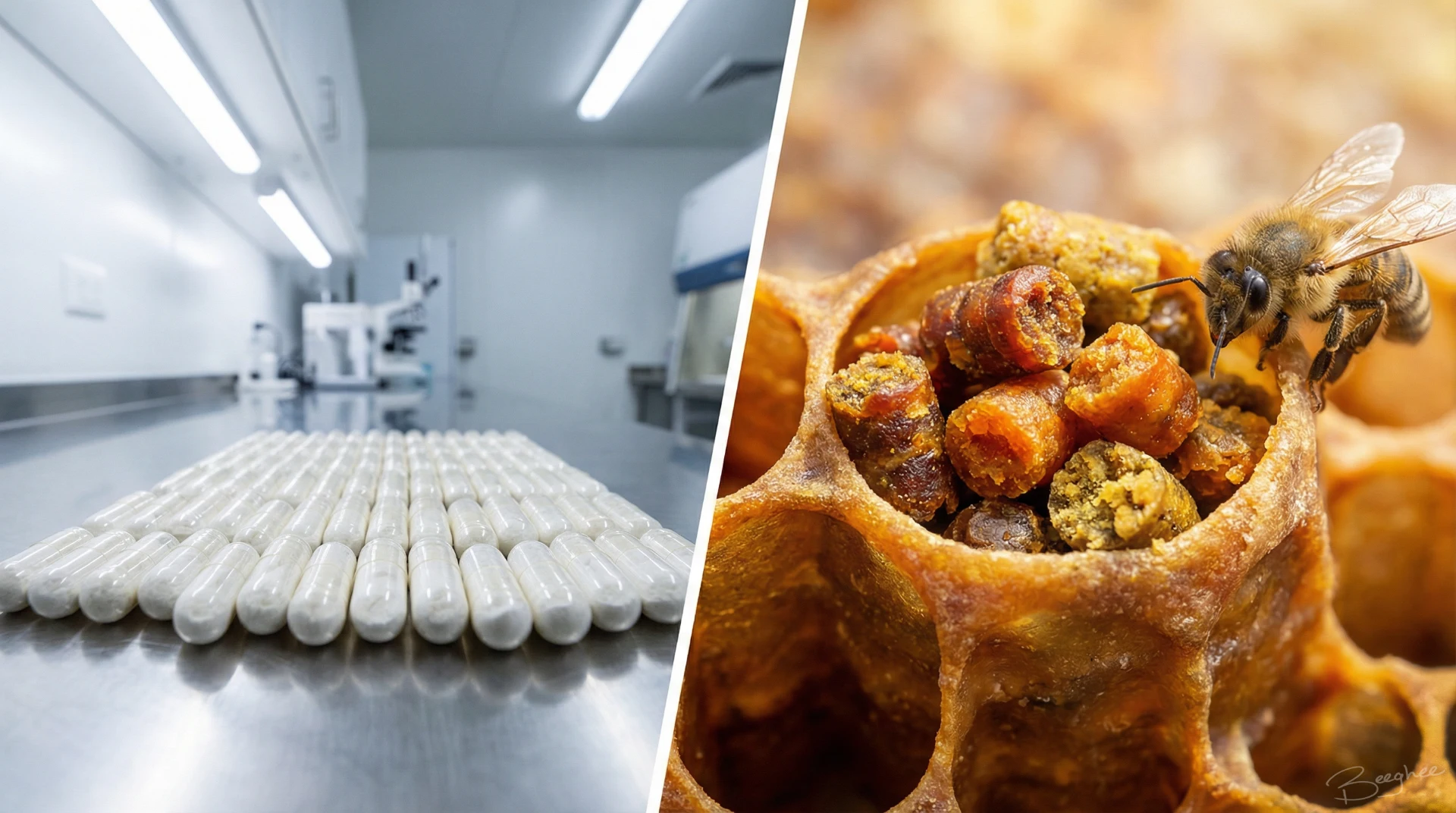
Here is our reading, and it's ours, not his. If anything in a hive literally is the love-life of the flowers, it's pollen, which carries the plant's male reproductive cells. The bees pack it into comb with honey and their own secretions, and lactic acid bacteria from the bees' honey stomach sour it and keep it from spoiling. That's bee bread: the colony's protein store, the food that shapes its workers and feeds the glands that make royal jelly.
That's what's in a jar of Beeghee: hive-fermented™ bee bread from smallholder beekeepers in Mexico. To see how the bees make it, start with The Fifth Ferment™.
The Century Scorecard
Here's how Steiner's 1923 bee talks hold up, claim by claim:
| Claim | Steiner, 1923 | What we know now | Verdict |
|---|---|---|---|
| The hive is one being | “The hive is a whole, a whole being.” | The colony works as a superorganism. It holds its brood near 35 °C, defends itself as a group, and keeps one food store for everyone. | Held up |
| Bought queens will cost us later | “This joy will not last a hundred years.” | Losses are severe, but driven mainly by Varroa mites and their viruses, pesticides and poor forage. Diversity and swarming, both left to the colony, are linked to better survival. | Right direction |
| Bees should eat nectar and pollen, not sugar | Sugar feeding is “really nonsense.” | Compounds in honey and pollen switch on detox and immune genes. Bees on sugar alone grow smaller brood-food glands. | Held up |
| Feeding decides queen or worker | “How one feeds has a very strong effect.” | Royal jelly alone makes a queen. Compounds in bee bread help steer a larva toward worker. | Held up |
| Bee development follows the Sun’s 21-day turn | The Sun turns once in about 21 days. | About 25 days at the Sun’s equator, about 34 near its poles, about 27 as seen from Earth. | Wrong |
| Bee venom for rheumatism | Correctly dosed, it can cure. | Small trials hint at pain relief, but the evidence is low quality and the allergy risk is real, including fatal anaphylaxis. | Unproven |
| Hexagons carry the force that forms quartz | Cells are “like quartz crystals, only hollow.” | The hexagon divides a surface into equal cells with the least wall, proven in 1999. How bees get there is still argued. | Poetry |
| Bees can barely see | Workers live in a kind of twilight. | Bees see color, including ultraviolet that we can’t. | Wrong |
| Honey for babies | Honey from nine or ten months old. | Health authorities advise no honey before 12 months, citing the risk of infant botulism. | Debated |
The Bottom Line
Steiner missed on a few details, like the Sun's rotation and how well bees see. He was right about the things that matter most: a hive is one being, bees should eat what the flowers give them, and squeezing a colony for short-term yield sends the bill to the next century.
In the first lecture of the series he said something that holds up better than almost anything else in it:
“Really, every person should take the greatest interest in beekeeping, because more in human life depends on it than one thinks.”
A hundred years on, we'd add one thing: take an interest in what the bees eat, too.
Steiner quotations are our own translations from the German stenographic transcripts (GA 351 and GA 348). The published English editions word them differently.
This article is for educational purposes and is not medical advice. Beeghee is a food, not a drug. Statements have not been evaluated by the FDA. Beeghee is not intended to diagnose, treat, cure, or prevent any disease. Beeghee contains honey and is not for infants under 12 months. If you are pregnant, nursing, taking medication, or have a medical condition, consult your healthcare provider before adding new foods to your routine.
Experience the Science
Ready to transform your gut health? Try Beeghee's hive-fermented bee bread – nature's most bioavailable superfood.
Shop BeegheeReferences
- [1]Steiner R. "Mensch und Welt. Das Wirken des Geistes in der Natur. Über das Wesen der Bienen" (GA 351). Lectures to the Goetheanum workers, Dornach, 8 October – 22 December 1923; the bee material is the postscript of 10 November and the lectures of 26 and 28 November and 1, 5, 10, 12, 15 and 22 December. 4th ed., Rudolf Steiner Verlag, 1988. English editions: "Nine Lectures on Bees" (tr. Pease & Mier), rsarchive.org/Lectures/GA351; "Bees" (tr. Braatz), Anthroposophic Press, 1998.
- [2]Steiner R. "Über Gesundheit und Krankheit" (GA 348), lecture to the Goetheanum workers of 3 February 1923. 3rd ed., Rudolf Steiner Verlag, 1983. Printed as the first lecture of the English "Nine Lectures on Bees".
- [3]vanEngelsdorp D, et al. "Colony collapse disorder: a descriptive study." PLoS ONE 4(8): e6481 (2009); US Environmental Protection Agency, "Colony Collapse Disorder."
- [4]Apiary Inspectors of America, Auburn University and Oregon State University, U.S. Beekeeping Survey: 2024–25 (annual colony loss 55.6%) and 2025–26, preliminary (39.9%). apiaryinspectors.org. Lamas ZS, et al. PLoS Pathogens 22(2): e1013939 (2026), on viruses and miticide-resistant Varroa in the 2025 losses.
- [5]Mattila HR, Seeley TD. "Genetic diversity in honey bee colonies enhances productivity and fitness." Science 317: 362–364 (2007).
- [6]Loftus JC, Smith ML, Seeley TD. "How honey bee colonies survive in the wild: testing the importance of small nests and frequent swarming." PLoS ONE 11(3): e0150362 (2016).
- [7]Mehring J. "Das neue Einwesensystem als Grundlage der Bienenzucht." Frankenthal (1869); Wheeler WM. "The ant-colony as an organism." Journal of Morphology 22: 307–325 (1911).
- [8]Kleinhenz M, et al. "Hot bees in empty broodnest cells: heating from within." Journal of Experimental Biology 206: 4217–4231 (2003); Tautz J, et al. "Behavioral performance in adult honey bees is influenced by the temperature experienced during their pupal development." PNAS 100: 7343–7347 (2003); Tautz J. "The Buzz about Bees: Biology of a Superorganism." Springer (2008).
- [9]Mao W, Schuler MA, Berenbaum MR. "A dietary phytochemical alters caste-associated gene expression in honey bees." Science Advances 1(7): e1500795 (2015); Zhu K, et al. "Plant microRNAs in larval food regulate honeybee caste development." PLoS Genetics 13(8): e1006946 (2017).
- [10]Brodschneider R, Crailsheim K. "Nutrition and health in honey bees." Apidologie 41: 278–294 (2010).
- [11]Mao W, Schuler MA, Berenbaum MR. "Honey constituents up-regulate detoxification and immunity genes in the western honey bee Apis mellifera." PNAS 110: 8842–8846 (2013); DeGrandi-Hoffman G, et al. Journal of Insect Physiology 56: 1184–1191 (2010).
- [12]Alaux C, Ducloz F, Crauser D, Le Conte Y. "Diet effects on honeybee immunocompetence." Biology Letters 6: 562–565 (2010); Di Pasquale G, et al. "Influence of pollen nutrition on honey bee health: do pollen quality and diversity matter?" PLoS ONE 8(8): e72016 (2013).
- [13]NASA, Sun Fact Sheet (nssdc.gsfc.nasa.gov); Wilcox Solar Observatory, Stanford, on the Carrington rotation (25.38 days sidereal, 27.2753 days synodic, defined 1863).
- [14]Hales TC. "The Honeycomb Conjecture." Discrete & Computational Geometry 25: 1–22 (2001; posted 1999); Nazzi F. "The hexagonal shape of the honeycomb cells depends on the construction behavior of bees." Scientific Reports 6: 28341 (2016).
- [15]Biodynamic Federation – Demeter International. International Demeter Biodynamic Standard, section 6.5, Beekeeping (2025 edition).
- [16]Lee JA, et al. "Bee venom acupuncture for rheumatoid arthritis: a systematic review of randomised clinical trials." BMJ Open 4: e006140 (2014); Park JH, et al. PLoS ONE 10: e0126971 (2015), on adverse events.
- [17]Vásquez A, Olofsson TC. "The lactic acid bacteria involved in the production of bee pollen and bee bread." Journal of Apicultural Research 48(3): 189–195 (2009); Anderson KE, et al. Molecular Ecology 23: 5904–5917 (2014).
- [18]US Centers for Disease Control and Prevention, foods and drinks to avoid for infants (no honey before 12 months).
Related Articles
The Fermentation Process
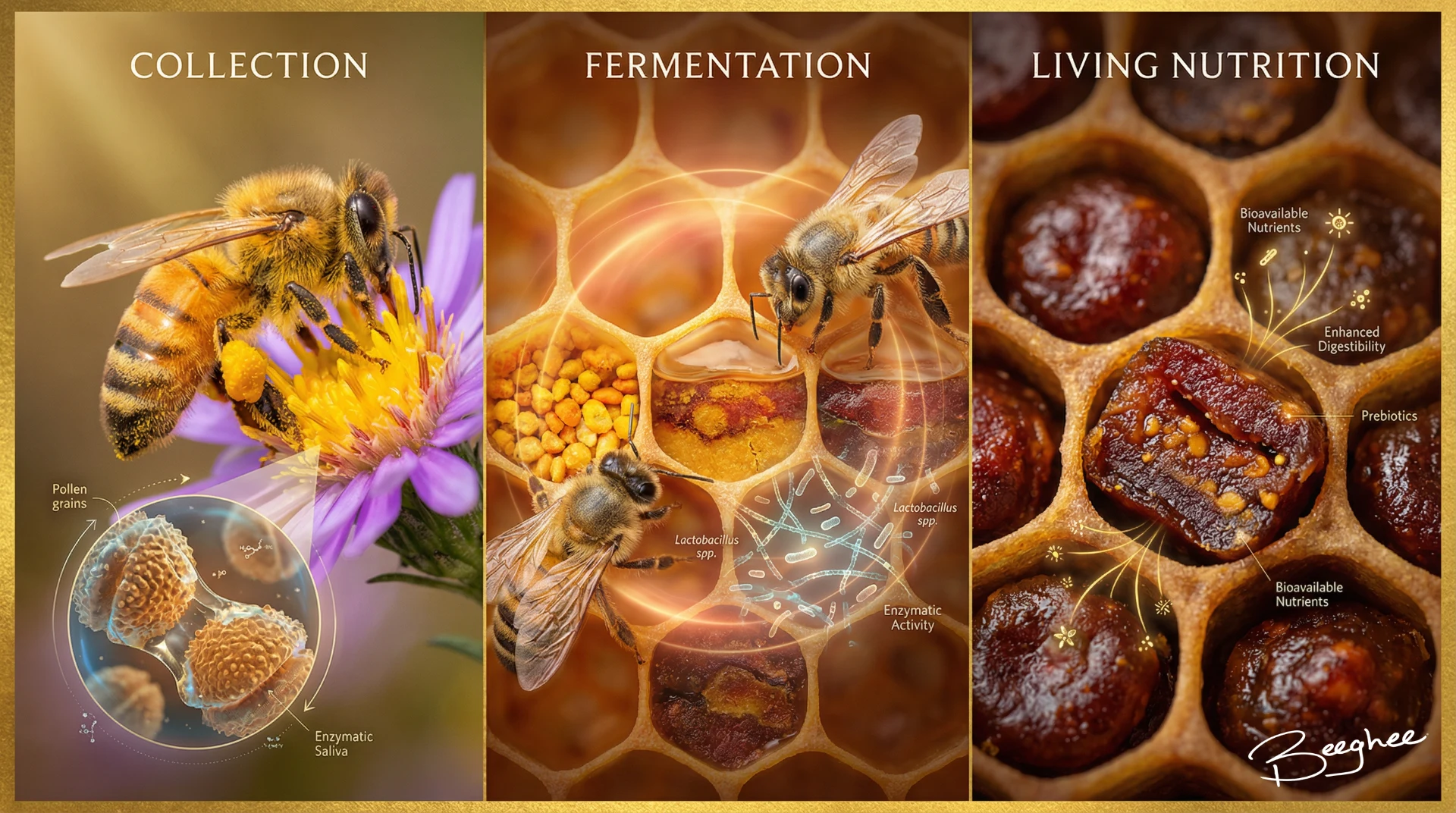
An in-depth look at how bees transform raw pollen into living bee bread through The Fifth Ferment.
Manuka Honey vs. Beeghee: Two Gifts from the Hive, Two Very Different Jobs
Destroying bad microbes and supporting a healthy microbiome
Why Bees Make Better Probiotics
Understanding why hive fermentation creates a more bioavailable probiotic food than manufactured supplements.